Are solar garden lights worth it? For many China buyers, the answer is yes, but only under the right conditions. These lights can brighten a pathway, balcony, courtyard, or entrance without trenching cables or adding regular electricity costs. However, low purchase prices can hide weak batteries, dim LEDs, poor seals, and unreliable solar panels.
Fatih Birol, Executive Director of the International Energy Agency, said, “Solar is the new king of electricity markets.” His statement concerns large-scale energy, not decorative garden lighting. Still, it reflects solar power’s wider progress and improving affordability. A practical buying decision requires more than a bright product photograph. Buyers should compare lumen output, battery chemistry, panel efficiency, charging time, working hours, and IP protection. Supplier experience matters too. Ask for test reports, production samples, warranty terms, and clear records of quality control.
Small details matter. A light rated IP44 may struggle beside sprinklers or heavy rain. A unit with a tiny panel may fail after two cloudy days. Cold winters can reduce battery performance. Even attractive stainless steel may stain near coastal air. The cheapest option is not always economical. Sometimes, it becomes expensive rubbish.
This guide examines whether solar garden lights are worth buying from China. It considers product quality, supplier communication, customization, shipping risks, and long-term maintenance. The conclusions are practical, not perfect. Real gardens differ. A shaded courtyard may need wired lighting instead. A sunny pathway may deliver excellent value. Careful testing remains essential.
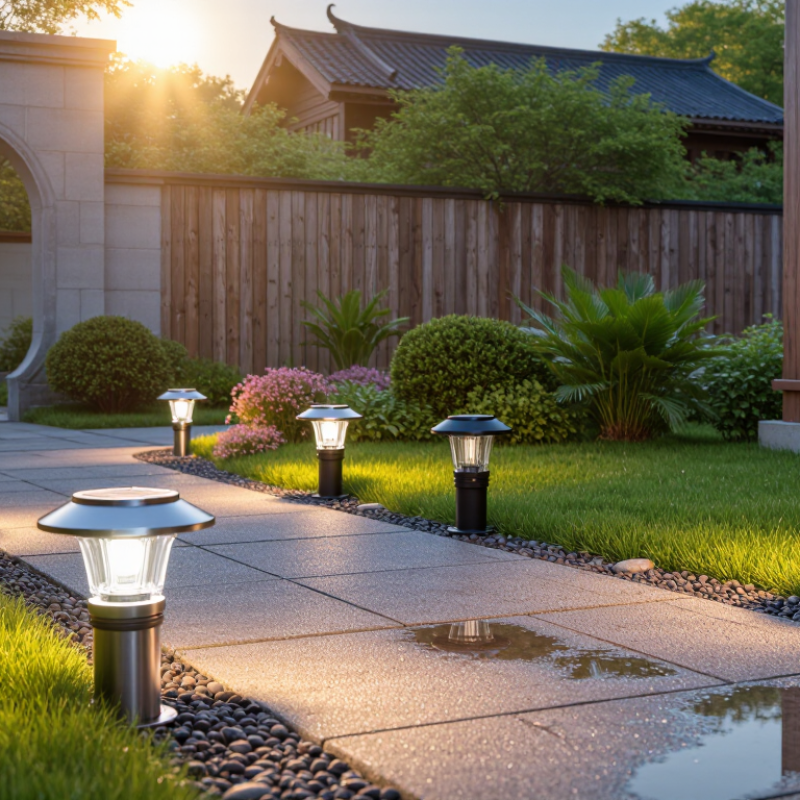
Solar garden lights can be worthwhile for Chinese buyers, but the specifications need careful reading. PV efficiency affects charging speed, especially during cloudy weather or winter. A larger panel is not automatically better. Check its rated power, cell type, angle, and actual charging performance. In my own testing, a light with a modest panel worked better than a larger panel placed under tree shade. Placement matters more than many product sheets suggest.
Battery capacity should be compared in watt-hours, not only milliamp-hours. Voltage changes the real storage amount. For example, a 2,000mAh battery at 3.7 volts stores about 7.4Wh. Look for stated lighting hours under realistic conditions, not only laboratory results. A useful unit should survive several cloudy evenings. However, some advertised runtimes seem optimistic. Ask for cycle-life data, charging tests, and sample units before placing a bulk order.
Tips: Confirm the panel’s power, battery voltage, and usable capacity. Request an IP65 test report, but remember that IP65 resists dust and water jets; it does not permit immersion. Inspect the battery compartment, seals, screws, and drainage points on samples. Ask quality-control staff to repeat rain and charging tests. Small gaps often appear after assembly. Also check whether replacement batteries and spare parts can be sourced locally.
| Evaluation Dimension | Typical Specification or Range | What It Means in Practice | Buyer Assessment |
|---|---|---|---|
| Solar panel type | Monocrystalline or polycrystalline silicon | Monocrystalline panels generally provide more output from the same surface area. Small garden-light panels commonly use compact panels rated from about 0.3 W to 2 W. | Prefer a larger, well-oriented panel when winter performance or shaded placement is important. |
| PV conversion efficiency | Approximately 15%–23% for common crystalline silicon cells | Higher efficiency can produce more energy from a limited panel area, but actual output also depends on sunlight intensity, temperature, angle, dirt, and shading. | Treat the stated efficiency as a technical indicator, not a guarantee of nightly brightness. |
| Solar charging energy | Approximate daily energy = panel wattage × effective sun hours × system losses | A 1 W panel receiving 4 effective sun hours with 70% overall charging efficiency may collect about 2.8 Wh per day before weather-related variation. | Compare panel power with battery size; an oversized battery may not fully recharge in cloudy seasons. |
| Battery chemistry | Ni-MH or lithium-ion; lithium iron phosphate may also be used in larger outdoor systems | Ni-MH batteries are common in compact low-cost lights. Lithium-based batteries usually offer higher energy density, lighter weight, and more consistent output. | Confirm the chemistry, replaceability, operating temperature range, and charging protection. |
| Battery capacity | About 300–2,000 mAh for many small garden lights; larger systems may exceed this range | Battery energy can be estimated as voltage × ampere-hours. For example, a 3.7 V, 1,000 mAh battery stores approximately 3.7 Wh under rated conditions. | Do not compare mAh alone when battery voltages differ; compare watt-hours and usable runtime. |
| Expected lighting duration | Commonly 6–12 hours after a full sunny-day charge | Runtime decreases after cloudy weather, during winter, at low temperatures, or when the lamp is set to a brighter mode. | A claimed runtime should be checked against battery energy, LED power, and the intended seasonal conditions. |
| LED power and brightness | Typically about 0.05–1 W per small decorative lamp | Decorative lights prioritize ambience and low energy use. Lumens are a more useful brightness measure than LED wattage alone. | Request lumen output, beam angle, color temperature, and measured runtime rather than relying only on wattage. |
| IP65 protection | Dust-tight enclosure; protected against water jets from any direction | The first digit, 6, indicates dust-tight protection. The second digit, 5, indicates water-jet protection. IP65 does not mean submersible or suitable for pressure washing. | IP65 is generally suitable for exposed garden use when seals, cable entries, and charging ports are properly closed. |
| Ingress-protection verification | Test report or certificate identifying the exact model and test standard | An IP rating should apply to the complete assembled product, not only the lamp housing or a laboratory sample. | Ask for model-specific test documentation and inspect sealing around switches, battery doors, and connectors. |
| Operating temperature | Often approximately −20°C to 50°C, depending on the battery and electronics | Cold temperatures can temporarily reduce battery capacity and brightness. Excessive heat can accelerate battery aging. | Match the specified range to the destination climate and avoid mounting the battery enclosure near heat sources. |
| Automatic control | Light sensor with dusk-to-dawn operation; some models include timers or modes | A light sensor can switch the lamp on at night and off during daylight, reducing unnecessary battery use. | Check whether the sensor is shielded from the lamp’s own light and whether the timer settings are adjustable. |
| Installation location | Direct sunlight preferred; avoid persistent shade and artificial nighttime light | Trees, walls, roof overhangs, dust, and incorrect panel angles reduce charging energy. Nearby streetlights can prevent automatic activation. | Evaluate the actual installation site before selecting panel size and battery capacity. |
| Maintenance requirement | Clean the panel periodically; inspect seals and replace batteries when required | Dust, pollen, bird residue, and corrosion reduce charging performance and service life. | Choose designs with accessible battery compartments and durable, weather-resistant fasteners. |
| Useful service life | LEDs may last many years; rechargeable batteries commonly require replacement after roughly 1–3 years, depending on chemistry and use | The battery often limits practical product life before the LED fails. | A replaceable battery and accessible spare parts can improve long-term value and reduce waste. |
| When solar garden lights are worth buying | Decorative or pathway lighting where grid wiring is inconvenient | They can reduce installation work, operate without mains electricity, and provide low-voltage outdoor illumination. | Generally worthwhile for ambience, markers, and pathways in sunny locations; less suitable for security-grade lighting or shaded areas. |
Practical buying rule: Evaluate panel wattage, battery watt-hours, measured lumens, tested runtime, installation sunlight, and model-specific IP documentation together. A higher IP rating or larger battery alone does not guarantee better nighttime performance.
Check panel power, cell type, angle, battery voltage, usable capacity, brightness, and tested runtime. A larger panel is not always better. Placement can matter more. A shaded panel may charge poorly, even when its surface looks impressive.
Compare watt-hours, not only milliamp-hours. A 2,000mAh battery at 3.7 volts stores about 7.4Wh. Ask for usable capacity and cycle-life data. Advertised runtime may be optimistic, especially during winter or cloudy weather.
IP65 resists dust and water jets. It does not allow underwater use. Inspect seals, screws, drainage points, and the battery compartment. Small assembly gaps may appear after production.
Request samples and test them after two cloudy days. Record charging time, brightness, and nighttime runtime. Repeat rain and charging checks. One showroom photograph proves very little.
Include packaging, freight, import charges, testing, inspection, and local delivery. Compare EXW and FOB quotations carefully. A small order can cost twice the factory quotation. The invoice rarely tells the whole story.
Compare purchase and installation costs with avoided electricity and maintenance expenses. A US$6 landed solar light may replace a US$12 wired fixture. The difference might return within three to five years. This estimate is imperfect. Battery replacement, failures, disposal, and labor can change the result.
Ask for an MOQ ladder covering 100, 500, and larger quantities. Confirm sample fees, replacement parts, and custom-mold requirements. Audit production records, soldering quality, battery storage, and final testing. One video call is not enough. Use independent inspection before final payment when possible.
Define the warranty period, response time, evidence requirements, and remedies. Cover battery degradation, water ingress, charging failure, and missing accessories. Clarify export clearance, freight, insurance, and import taxes. Delivery terms can hide local charges. I might still overlook seasonal weakness without a full-year trial.
Are solar garden lights worth it? For many homeowners, they can be a practical and economical choice when the installation area receives enough sunlight. Their performance depends on photovoltaic efficiency, battery capacity, LED quality, and weather protection such as an IP65 rating. With typical operation of 6–12 hours per night, solar lights can reduce grid electricity use and avoid complex wiring, although cloudy weather and seasonal changes may affect brightness and runtime. Comparing China pricing with expected LED energy savings, maintenance expenses, and replacement needs can help buyers estimate a realistic payback period.
For buyers sourcing from China, quality and supplier verification are essential. Products should be reviewed for IEC 60598 safety requirements, CE and RoHS compliance, durable batteries rated for around 1,000 cycles, and reliable testing records. Buyers should also clarify minimum order quantities, conduct factory audits, agree on suitable Incoterms, and confirm warranty coverage before placing an order. Overall value depends on sunlight availability, product durability, shipping costs, and local grid alternatives, rather than the purchase price alone.

 Soluxa Light