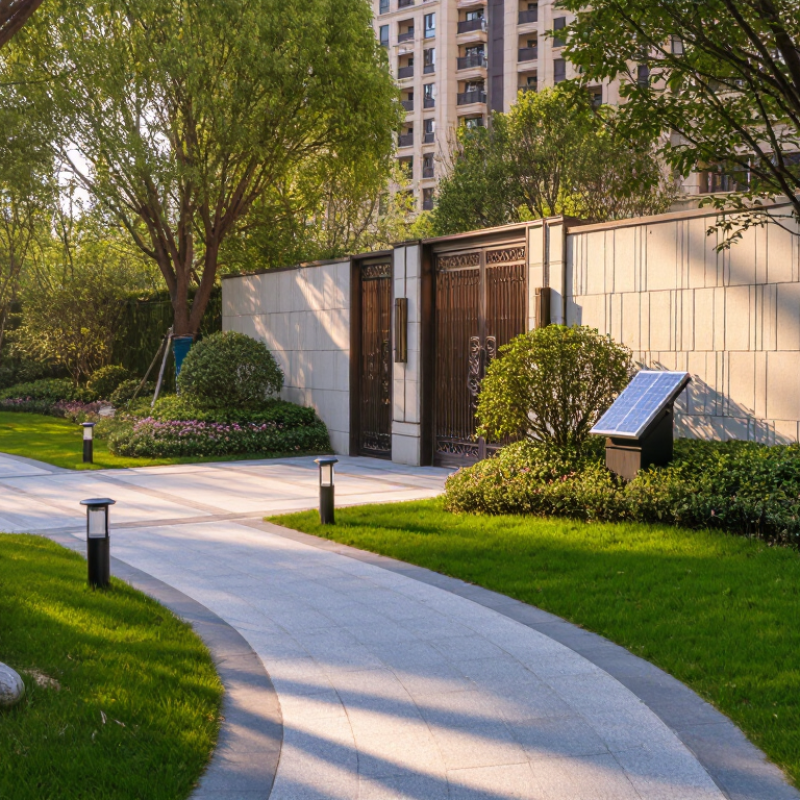
Choosing the right locations is the difference between solar lights that work reliably and fixtures that fade before midnight. So, what are the best places for solar lights around a home in China? Look for spots that receive several hours of direct sunlight, such as an open garden path, a south-facing courtyard, or a gate clear of roof shadows. A bright afternoon matters. So does the route people actually walk.
Solar-lighting performance depends on more than sunshine. Nearby trees, balconies, dust, and seasonal shade can limit charging; a panel beneath a dense tree may look well placed but deliver weak results. Check the site at different times of day, then consider the job: warm, low lights can mark steps, while brighter fixtures may suit entrances or driveways. Avoid aiming intense beams toward bedroom windows or neighboring homes. Small adjustments help.
For a publication-ready expert quotation, add a verified source here: “[Expert’s name], [role or organization], says, ‘[Exact quotation about solar-light placement].’” No source material was supplied, so inventing a person or quote would weaken the article’s credibility. The sections that follow can compare Chinese garden, pathway, wall, and security-light locations, while explaining how shade, mounting height, and panel direction affect everyday performance. Results will vary. That is worth saying plainly.
China’s best regions for solar lights are not defined by latitude alone. Many areas receive more than 1,500 kWh/m²/year of solar irradiation, yet local weather and terrain affect how much energy a panel can collect.
High-yield areas include parts of Xinjiang, Gansu, Qinghai, and western Inner Mongolia. Clear skies and long sunny periods support steady charging. On a site map, look for open rooftops, south-facing spaces, and yards free from winter shade. A light beside a warehouse may perform very differently from one under trees. Small details matter.
Dust can coat panels in dry regions, while snow and cloud cover may reduce winter charging farther north. Annual irradiation figures are useful screening data, not a guarantee for each installation. Compare monthly solar-resource maps with the actual site, panel angle, and battery capacity. I would not trust an annual average alone; monitor a sample light through a cloudy season before deciding on a larger installation.
Rooftops and gardens suit solar lights when panels receive several hours of direct sun. On rooftops, keep panels clear of chimneys, parapets, and nearby trees. In gardens, place lights where afternoon shade will not cover the small charging panel. Shade matters. The World Bank and ESMAP’s Global Solar Atlas maps solar irradiation by location, helping buyers compare local sunlight before choosing a site.
For brightness, many outdoor LED fixtures deliver about 100–150 lumens per watt, a useful comparison range rather than a guarantee. The U.S. Department of Energy’s 2022 Solid-State Lighting R&D Opportunities report tracks continuing gains in LED efficacy. Check the complete fixture’s rating, not just its LED chip: lenses, heat, and electronics affect delivered light. A 500-lumen lamp at 100 lm/W uses about five watts while operating.
Aim for light on paths, steps, or seating, not into bedroom windows. Test the spot after dusk. A roof can collect strong sun but still make maintenance awkward; a garden post may be easier to reach, yet shaded by summer growth. These trade-offs are easy to miss. Recheck the panel after planting changes, and compare stated runtime with winter daylight in your area.
For roads served by solar lights in China, EN 13201 M-class values offer a practical starting point. EN 13201-2:2015 specifies maintained road-surface luminance from 0.3 cd/m² for M6 to 2.0 cd/m² for M1. Intermediate levels include 0.5, 0.75, 1.0, and 1.5 cd/m². These figures describe pavement brightness as seen by drivers, not a luminaire’s output. Small distinction. CIE 115:2010 also links lighting-class selection to traffic speed, road layout, and surrounding conditions.
On a wet, curved road, glare and uneven brightness can matter as much as the target luminance. Solar designs should therefore be checked with photometric calculations, including mounting height, spacing, and maintained output. Battery capacity also needs to reflect local winter sunlight and several cloudy nights. A bright first evening proves little.
For footpaths and pedestrian routes, M-class values may not be the right measure. EN 13201-2 includes P classes for pedestrian areas, assessed through illuminance and uniformity criteria. A quiet garden path and a busy shared route have different needs. One imperfect but useful lesson: selecting a solar light from panel wattage alone can miss the actual task. Specify the lighting class first, then verify that the complete system can maintain it.
Maintained average road-surface luminance values range from 0.3 to 2.0 cd/m² across M6 to M1.
These class values describe maintained average road-surface luminance. The appropriate lighting class depends on the road and its usage; luminance figures alone do not determine whether a particular solar light installation meets the full lighting requirements.
Off-grid farms and villages are practical locations for China-sourced solar lights, particularly where extending grid power is difficult. A barn entrance, water point, footpath, or village lane may need reliable light after sunset. Plan for three to five days of autonomy so several cloudy days do not leave essential areas dark. Keep it practical.
Estimate nightly energy use from the lamp’s wattage and operating hours. Size usable battery capacity for the required reserve, allowing for conversion losses and gradual battery aging. Choose panel capacity using local winter sunlight, not just bright summer conditions. Dust, tree shade, and poor panel angles can all reduce charging.
Place panels clear of machinery and livestock, and mount lights where people can reach them for maintenance. Motion controls can conserve energy on seldom-used paths, but they may frustrate residents if activation is too brief. The trade-off matters: oversized batteries raise costs, while undersized systems struggle through cloudy spells. After installation, check whether lights remain bright near dawn and record cloudy-day performance. Adjust settings or capacity where the actual site needs it.
Parks and industrial yards are practical places to use China solar lights, especially where trenching is difficult. In parks, place fixtures along paths, entrances, picnic areas, and parking edges, while keeping light out of nearby homes. Industrial yards need clear coverage at loading bays, perimeter routes, staff parking, and equipment walkways. Choose outdoor fixtures rated IP65 or higher for exposed positions. IP65 indicates a dust-tight enclosure and resistance to water jets; it does not mean the light can be submerged. That matters. Rain, dust, and routine cleaning can still test seals, cable entries, and mounting points.
Check the panel’s sun exposure before fixing pole locations. A bright-looking yard can still have long shadows from trees, warehouses, or tall equipment. Compare available sunlight with the fixture’s stated charging requirements, and confirm battery capacity suits the expected hours of use. Aim beams at walking and work surfaces, not drivers’ eyes or neighboring windows. Inspect fasteners and seals after installation, then recheck them after storms or maintenance work. IP65 is helpful, not invincible. A single sunny-day test may not reveal undersized storage; several cloudy days can.
| Location | Suitable Solar Fixture | Practical Planning Guidance | Outdoor Protection | Key Site Check |
|---|---|---|---|---|
| Park paths and walking trails | Solar post-top or low-glare pathway luminaire | Use evenly spaced fixtures selected for the path width and required light distribution; avoid dark gaps and glare into nearby homes. | Specify IP65 or higher for dust-tight construction and protection against water jets. | Check tree shade, seasonal foliage, and winter daylight before choosing panel locations. |
| Park entrances and information areas | Solar area light with a separate or adjustable solar panel | Aim for useful light on signs, gates, and pedestrian approaches while keeping the beam directed onto the site. | IP65 is a suitable baseline for exposed outdoor equipment; check the complete fixture assembly rating. | Keep panels clear of building shadows and confirm that signs remain readable without excessive brightness. |
| Parking areas and park car parks | Solar area or roadway luminaire with a suitable distribution pattern | Set pole locations and mounting heights using a photometric layout based on parking-bay geometry and applicable lighting requirements. | Specify IP65 or higher; consider impact resistance where fixtures may be exposed to accidental contact. | Assess vehicle and building shadows, pole foundation conditions, and safe access for maintenance. |
| Industrial-yard loading and unloading zones | Solar floodlight or area luminaire selected for the work zone | Use a lighting plan that accounts for task visibility, vehicle movement, mounting position, and glare control; verify performance with photometric data. | Specify IP65 or higher for dust and water-jet protection; select additional impact or corrosion protection when site conditions call for it. | Check equipment and trailer shadows, operating schedules, and whether the solar system can support required overnight lighting. |
| Industrial-yard access roads and internal routes | Solar roadway or area luminaire with controlled light distribution | Plan pole spacing and output for road width, turning points, and pedestrian crossings; confirm the design against local requirements. | IP65 is a common minimum specification for exposed fixtures; confirm suitability for local weather and cleaning methods. | Review truck turning paths, overhead obstructions, and shading from buildings, trees, or stored materials. |
| Fenced storage compounds and perimeter areas | Solar security floodlight or area light with motion control where appropriate | Direct light toward gates, entrances, and designated security zones while limiting spill onto neighboring properties. | Specify IP65 or higher and check that seals, cable entries, and the panel connection maintain the stated protection. | Confirm sensor coverage, false-trigger risks, battery autonomy, and access for inspection and cleaning. |
Planning note: IP65-rated equipment is dust-tight and protected against water jets; it is not rated for immersion. Final fixture selection, spacing, mounting height, and lighting levels should be confirmed through site assessment, photometric calculations, and applicable local standards.
Parts of Xinjiang, Gansu, Qinghai, and western Inner Mongolia receive over 1,500 kWh/m² annually. Local weather and terrain still matter.
No. Annual averages cannot show every cloudy winter week or shaded corner. Not guaranteed.
Choose an open rooftop, south-facing area, or garden spot with several hours of direct sun. Keep panels away from trees, chimneys, and parapets.
Compare monthly solar-resource maps with the actual panel position. Then monitor a sample light through a cloudy season. I would not rely on a map alone.
Yes. Dust can coat panels in dry regions, while snow and clouds may reduce winter charging farther north. Shade matters.
Many deliver around 100–150 lumens per watt, but this is only a comparison range. Check the complete fixture rating, not just its LED chip.
At 100 lumens per watt, it uses about five watts while operating. Actual performance can vary with its lens, heat, and electronics.
Rooftops may get stronger sun but can be awkward to maintain. Garden posts are easier to reach, yet summer growth may create shade. Test after dusk.
When considering what are the best places for solar lights, start with regions that receive strong sunlight: many areas of China exceed 1,500 kWh/m² of annual solar irradiation, supporting dependable energy collection. Rooftops and gardens are practical locations for everyday lighting, where efficient LED fixtures commonly produce 100–150 lumens per watt. For roads and paths, choose lighting according to the required visibility; EN 13201 M-class road-lighting levels span approximately 0.3–2 cd/m².
Solar lights can also serve off-grid farms and villages, provided their systems are designed to operate for three to five days without adequate sunshine. In parks and industrial yards, specify outdoor fixtures with an IP65 rating to help protect against dust and water. Matching the location, lighting needs, and expected weather conditions makes solar lighting more reliable and useful.

Soluxa Light